90 Day CRM Data Enrichment for RevOps: Sequence, Governance, AI
A practical RevOps playbook to stabilize CRM data in 90 days: hygiene first, dedupe, supervised AI for survivorship, plus governance and SLAs.
On this page
CRM data enrichment is the process of appending and continuously refreshing contact, firmographic, technographic, and relationship data so your CRM stays reliable for routing, scoring, and outreach. The recommended path is straightforward: treat enrichment as infrastructure, not a one-time cleanup, and pair it with hygiene and survivorship rules before you scale it. Start by running a sample enrichment pass on one high-value segment to see match rates and coverage gaps before committing budget.
TL;DR:
- Continuous enrichment should aim for coverage above 80 percent, especially on older records, to maintain routing, scoring, and segmentation accuracy.
- Integration approaches vary from native connectors for speed to API integrations for control, with middleware offering a balance but requiring monitoring.
- Enrichment must be sequenced correctly: deduplicating first, then enriching at capture, with governance rules and survivorship logic in place to prevent conflicts.
- Pilot programs in small segments and ongoing KPI tracking ensure data quality improves steadily without over-investing upfront.
- Compliance with GDPR and CCPA requires traceable provenance, explicit consent, and careful handling of personal and technographic data throughout the process.
What CRM Data Enrichment Does for Go-to-Market Teams
Sales reps lose hours every week chasing bad phone numbers, stale titles, and contacts who left the company two quarters ago. Enrichment fixes the underlying problem rather than the symptom. When contact and firmographic data stays current, sellers spend more time talking to the right person and less time verifying whether that person still exists at that company.
The business case rests on a simple, uncomfortable fact: B2B contact data decays at a significant rate annually. That means a CRM you cleaned thoroughly last January is meaningfully stale by this January, even if nobody touched a single record. A one-time cleanse buys you a few good quarters. Continuous enrichment is what keeps the gains from evaporating.
The downstream effects show up in three places most RevOps leaders already track:
- Routing accuracy improves when firmographic fields (employee count, industry, revenue band) are current enough to trigger the correct assignment rules instead of dumping leads into a generic queue.
- Lead scoring gets more honest when technographic and intent signals reflect what a company is actually using and researching right now, not six months ago.
- Segmentation and campaign match rates climb because email and phone data that bounces less means your list actually reaches the audience you built it for.
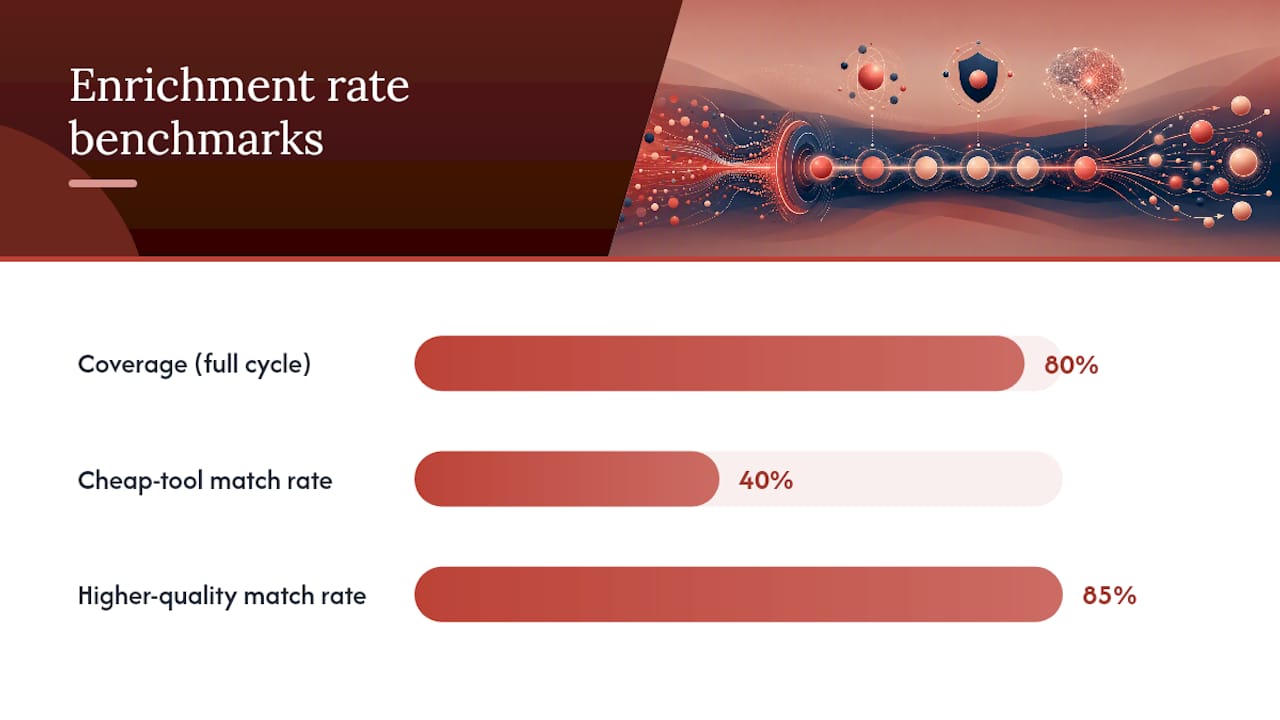
Enrichment coverage below a moderate threshold is a warning sign. It usually means your models and your sales team are operating on partial information, and the gap tends to concentrate in older records that nobody has touched since import. ZoomInfo’s guidance on CRM data quality frames healthy coverage as north of 80%, with anything under 40% on legacy records signaling a batch-only process that has quietly stopped working.
None of this is about chasing perfect completion rates. A record with 98% of its fields filled in is worthless if half of those fields are wrong. Confidence and freshness matter more than raw completeness, which is a distinction most teams get backward when they first invest in enrichment.
How to Evaluate Enrichment Approaches Without Picking a Vendor Blind
Comparing enrichment approaches on marketing claims alone is how teams end up disappointed six months into a contract. The fix is running your own test before you sign anything, and being specific about what you measure.
Start with the benchmarks you should expect from a functioning setup. Coverage, meaning the percentage of records with usable enrichment data, should trend toward 80% or higher once a system has been running for a full cycle, per the coverage benchmarks ZoomInfo outlines.
Integration architecture is where a lot of the real cost hides. Consider three tradeoffs:
- Native connectors are the fastest to deploy and usually the most limited in what fields they can touch or how much logic you can layer on top.
- API integrations give you full control over field mapping, confidence thresholds, and review gates, but they require engineering time to build and maintain.
- Middleware or iPaaS platforms sit in between, offering more flexibility than a native connector without the full engineering lift of a custom API build, at the cost of another system to monitor.
Cadence matters just as much as connection type. Continuous, event-triggered enrichment (a record updates the moment new information becomes available) keeps data fresher than scheduled batch jobs, but it also means more write volume hitting your CRM and more potential for conflicting updates if your governance rules aren’t tight. ZoomInfo’s research on CRM hygiene makes the case that continuous refresh is what actually prevents the rapid decay that follows a one-time batch append.
Provenance and confidence scoring separate serious approaches from cosmetic ones. Every enriched field should carry a record of which source supplied it, when it was last updated, and how confident the system is in that value. Without this, you can’t build sane survivorship rules, and you can’t audit why a field changed when a rep asks.
Pricing shapes vary widely, from per-record credits to flat platform fees to usage-based API pricing. The number that actually matters is cost-per-enriched-record that clears your confidence threshold, not the sticker price of the plan. A cheap tool with a 40% match rate can cost more per usable record than a pricier one with an 85% match rate.
Pro Tip: Pull 200 to 500 records from your CRM that represent a real mix of account sizes and record ages, strip the enrichable fields, and run them through whatever approach you’re evaluating. Testing on a sampled dataset before you commit tells you more in an afternoon than any vendor deck will in a month.
Run these five checks on that sample: match rate against known-correct values, coverage across firmographic and technographic fields, how the tool handles records that update job titles or company names, latency between a triggering event and an updated record, and how cleanly the output maps to your existing CRM fields without a manual remapping project.
The Right Order: Hygiene, Dedupe, Enrich, Route
The sequence you follow matters more than which tool you pick. Enrichment layered onto a messy database just makes the mess more expensive.
1. Build governance before you touch a single record. Write a data dictionary that defines what each field means, who owns it, and which fields enrichment is allowed to update automatically versus which require human review. This sounds bureaucratic. It’s the single step that prevents the most common failure mode later.
2. Deduplicate and normalize the existing backlog. Enrichment should never run on duplicate records, because you end up paying to enrich the same account twice and risk writing conflicting updates across the copies. Standardize formats, naming conventions, and picklist values first.
3. Enrich at the point of capture. Add validation and enrichment triggers to your web forms and lead capture flows so records arrive in the CRM already appended, rather than sitting incomplete until a batch job catches up days later.
4. Orchestrate your sources with confidence thresholds. Set up the waterfall: which source gets checked first, what confidence score triggers an automatic write, and what falls below that line into a review queue instead.
5. Route only after enrichment completes. The sequence of capture, enrich, score, then route meaningfully cuts lead-handling time compared to routing on raw, unenriched data and fixing it after the fact.
Rollout should happen in stages, not as a company-wide flip of a switch:
- Pilot on a single segment or territory first, ideally one with enough volume to be statistically meaningful within a few weeks.
- Monitor contactability, bounce rate, and duplicate rate daily during the pilot window, not just at the end.
- Define a rollback procedure before you launch. If duplicate rate spikes or bounce rate climbs instead of falling, you need a plan to pause enrichment writes without breaking the pipeline.
- Expand cohort by cohort only after the pilot clears your success thresholds.
Pro Tip: Deduping before enriching isn’t just about data cleanliness. It’s about not paying twice for the same contact record and then having two conflicting versions of “current job title” fighting for space in your CRM.
Running Enrichment as Infrastructure: SLAs, Metrics, and Ownership
Enrichment that works for a quarter and then quietly degrades is worse than no enrichment at all, because teams keep trusting data that’s no longer accurate. Running it as infrastructure means someone owns it, metrics get checked on a schedule, and drift gets caught before it does damage.
The core KPIs worth tracking, along with rough benchmarks for a healthy program:
| Metric | Healthy benchmark | Warning sign |
|---|---|---|
| Enrichment coverage | Generally high, and consistent across record ages | Low overall, or concentrated in older records |
| Contactability (valid email/phone) | Trending upward month over month | Flat or declining despite enrichment spend |
| Bounce rate | Low single digits | Climbing quarter over quarter |
| Duplicate rate | Near zero after dedupe pass | Rising after enrichment runs, signaling a dedupe-before-enrich failure |
| Speed-to-lead | Minutes, not hours | Routing delays tied to incomplete enrichment before scoring |
These benchmarks come from the operational framework RevOps teams use to sustain CRM data hygiene, which pairs governance with continuous monitoring rather than periodic audits alone.
Cadence matters as much as the metrics themselves:
- Weekly: spot-check a sample of newly enriched records for accuracy, and review any low-confidence updates sitting in the review queue.
- Monthly: run the full KPI dashboard, segment coverage by record age, and flag accounts where enrichment coverage has dropped.
- Quarterly: revisit survivorship rules and field-level write permissions, since what made sense when you launched the program often needs adjusting as your CRM schema evolves.
Ownership should sit with RevOps or a dedicated CRM admin, not with whichever team happens to notice a problem first. Field-level write permissions need to be explicit: which fields can enrichment update automatically, which require a rep or admin to approve, and which stay locked to preserve rep-entered context like call notes or first-touch source.
Audit trails are non-negotiable. Every enriched field should log which source supplied the value, the date it was written, and the confidence score at the time. Without that trail, you can’t investigate why a field changed, and you can’t build trust with a sales team that’s understandably skeptical of automated writes touching their pipeline.
Drift shows up quietly: a source starts returning lower-confidence matches, a connector silently stops syncing, or duplicate rate creeps up because a new lead source bypassed your dedupe step. Escalation paths need to be defined ahead of time, with a named owner who gets alerted when coverage or bounce rate crosses a threshold, not discovered three months later during a quarterly review.
Wiring Enrichment Into Your CRM: The Technical Patterns
The integration pattern you choose determines how much control you have and how much maintenance burden your team takes on. Three approaches dominate in practice.
Native connectors, built by the enrichment provider for your specific CRM, deploy fastest and require the least engineering effort. They also tend to offer the least flexibility around custom field mapping and conditional logic, which matters once your governance rules get specific.
Custom API integrations give full control over confidence thresholds, review gates, and exactly which fields get touched under what conditions. They require ongoing engineering ownership, which is a real cost most teams underestimate at kickoff.
Middleware and iPaaS platforms sit between the two, letting you build conditional logic and multi-source orchestration without a from-scratch API build. The tradeoff is another system in your stack that needs monitoring.
Real-time, event-triggered flows meet speed-to-lead targets in a way scheduled batch jobs simply can’t. A webhook that fires enrichment the moment a form submits gets a rep working a fresher lead within minutes. A nightly batch job means every lead captured during the day sits unenriched until the next run, which directly undercuts routing accuracy for the highest-intent leads.
A few non-negotiables for the pipeline itself:
- Dedupe before enrich, every time, with the dedupe check running as a gate in the pipeline rather than a manual step someone remembers to do later.
- Field mapping rules documented explicitly, so an enrichment source’s “company_size” doesn’t silently overwrite your CRM’s “employee_count” with a different counting methodology.
- Observability on the pipeline itself: track enrichment latency, error rates on API calls, and the percentage of records that fail to match any source.
- Security review baked into planning, covering how enrichment vendors receive and store your contact data, and whether that arrangement satisfies your own data processing agreements.
Using Supervised AI to Make Enrichment Safer
The riskiest part of enrichment isn’t the data itself. It’s the automatic overwrite. A model that confidently replaces a rep’s carefully typed note with a generic vendor field is how trust in the whole system collapses in a single afternoon.
Supervised AI models handle this differently than fully automated pipelines. Instead of writing directly to the record, the model suggests a survivorship decision (which value wins when two sources disagree, or whether a blank field should be filled) and routes anything below a confidence threshold to a human reviewer before it touches the CRM. This preserves the speed benefit of automation while keeping a person in the loop exactly where judgment calls actually happen.
A workable pattern for the review queue:
- High-confidence matches (a verified email from a trusted source filling a blank field) write automatically.
- Low-confidence updates, or any update to a field marked as rep-owned, route to a reviewer with the source, confidence score, and proposed value displayed side by side.
- Every automatic write logs its source and timestamp so a reviewer or admin can trace back any change later.
- Reviewers can bulk-approve patterns they trust and bulk-reject sources that keep producing bad matches, which trains the system’s routing over time.
Pilot programs built this way tend to surface their biggest wins in the first month, simply because that’s when the backlog of obviously-safe updates clears out and the harder edge cases start showing up in the review queue. Expect early pilots to spend more reviewer time upfront and less as thresholds get tuned.
A clean handover to an internal ops team includes documentation of every survivorship rule, a runbook for what to do when a source starts producing bad matches, and monitoring dashboards the team can read without needing the person who built the system. Theodorosampas builds AI systems that write back into a CRM under human review specifically so the receiving team keeps full visibility into what the model is doing and why.
Pro Tip: If a field has ever caused a dispute between sales and marketing about “who owns this,” that’s exactly the field to route through human review first, not last.
Privacy and Compliance in Enrichment Programs
Enrichment touches personal data, which means GDPR and CCPA obligations apply the moment you’re appending or refreshing contact records for anyone in the EU or California, respectively. The two frameworks share a core requirement: you need a lawful basis for processing that data, and you need to be able to explain where it came from.
GDPR requires documenting the source and purpose of any personal data you append, and it gives individuals the right to access, correct, or request deletion of their data, including data your enrichment vendor supplied. That means your survivorship and audit logging aren’t just operational nice-to-haves. They’re what lets you actually respond to a deletion request without guessing which fields came from where.
CCPA gives California residents similar rights to know what personal information a business holds and to opt out of its sale, which matters directly if your enrichment vendor is itself selling or licensing contact data as part of its business model.
Practical steps that reduce exposure:
- Confirm your enrichment vendor’s data sourcing methods align with your own compliance obligations, not just their marketing claims about “verified” data.
- Maintain records of processing activities that include enrichment as a distinct data flow, not folded silently into general CRM usage.
- Build deletion and correction requests into your enrichment pipeline logic, so a request doesn’t require a manual hunt through multiple source systems.
- Treat any technographic or intent data tied to an identifiable person with the same scrutiny as contact data, since regulators increasingly don’t distinguish between the two.
None of this should discourage enrichment. It should push you toward vendors and internal processes that treat provenance and consent as core features rather than afterthoughts.
Where Enrichment Programs Break Down
Most enrichment failures trace back to one of a handful of predictable mistakes, and nearly all of them are avoidable with the right sequencing.
Enriching before deduplicating is the most common one. Teams get impatient, skip the dedupe pass, and end up paying to enrich the same contact under three slightly different record variants, then dealing with three different “current” answers to the same question.
No survivorship rules is a close second. Without a clear policy on which source wins in a conflict, enrichment can quietly overwrite accurate rep-entered context with generic vendor data, and nobody notices until a rep complains that their notes disappeared.
Treating coverage as the finish line misses the point entirely. A high completion percentage on inaccurate or stale data is worse than a lower percentage of trustworthy fields, since the CRM’s users can’t tell the difference just by looking at a filled-in cell.
Batch-only refresh cycles feel efficient until you measure the decay between cycles. A quarterly batch job means some records sit stale for up to three months, undercutting exactly the freshness enrichment was supposed to deliver.
Skipping the pilot stage is a mistake teams make under deadline pressure, rolling enrichment out company-wide before confirming match rates and coverage on a representative sample. The fix costs almost nothing: run a smaller test first, catch the integration issues on 300 records instead of 300,000.
The common thread across all five: enrichment works when it’s sequenced and governed, and it degrades fast when it’s treated as a plug-in that runs itself.
What Successful Enrichment Programs Actually Look Like
The pattern across effective enrichment rollouts isn’t a specific tool choice. It’s discipline in sequencing and a willingness to measure results honestly instead of celebrating a high completion percentage.
Programs that hold up over time tend to start narrow: one segment, one clear success metric, and a short pilot window before expanding. A sales team piloting enrichment on a single territory can compare contactability and bounce rate before and after, and that comparison is far more convincing internally than any vendor benchmark, because it’s their own data.
The programs that stall almost always skipped governance at the start. They enriched a messy, duplicate-heavy database, saw duplicate rate climb instead of fall, and lost internal trust in the whole initiative before the underlying sequencing problem got identified and fixed.
The four-part operational framework that pairs governance with continuous monitoring shows up repeatedly in programs that sustain their gains past the first quarter: set the rules, enrich at capture, clear the backlog, then monitor continuously rather than checking in occasionally. Teams that treat this as a one-time project instead of an ongoing operating model tend to be back at square one within a year, which tracks with how quickly contact data decays without active maintenance.
The lesson holds across company size and industry: enrichment succeeds when someone owns it as infrastructure, not when someone buys it as a feature.
A 90-Day Path to Stabilizing Your CRM Data
If you’re building a business case internally or scoping outside help, ninety days is enough time to move from a messy CRM to a working, governed enrichment pipeline with evidence to show for it.
Days 1 to 30: Audit. Map your current data quality across contactability, duplicate rate, and enrichment coverage by record age. Involve your CRM admin, a RevOps lead, and someone from security or legal early, since compliance requirements shape what you can build later. The deliverable is a written data dictionary and a governance policy covering field ownership and survivorship rules.
Days 30 to 60: Quick wins and pilot design. Clear the deduplication backlog on your highest-value segment and stand up a pilot enrichment flow with confidence thresholds and a review queue for uncertain updates. This is where you decide native connector, API, or middleware based on what your team can realistically maintain.
Days 60 to 90: Pilot run and handover. Monitor contactability, bounce rate, and duplicate rate weekly during the pilot. Success looks like measurable improvement on those three metrics against your Day 30 baseline. The handover package should include documented survivorship rules, a runbook for common failure modes, and a monitoring dashboard your team can read without outside help.
Whether you hire outside help or build this internally comes down to bandwidth and existing expertise. Teams with a strong CRM admin and some data engineering capacity can often run this playbook themselves. Teams stretched thin on both fronts tend to get further, faster, working with someone who has built these systems before and can hand over a program the internal team actually understands and controls. If you’re weighing that decision, Theodorosampas works directly inside a company’s existing tools to build exactly this kind of supervised enrichment pipeline, with the handover built into the engagement from day one.
Theodor