Theodoros Ampas works directly with lean company teams to build adaptive AI systems inside their existing tools, then documents and transfers ownership. He is also the founder of SimplyAI and writes about AI systems, agents, automation, web fundamentals, SEO, and GEO.
Where AI actually changes a travel agency's workflow: the rebooking decision inside a disruption is automating. Reconciling that change across every other supplier on the trip still isn't.
Most 'AI for dental clinics' content points to chatbots. The actual high-value automation target is insurance eligibility verification and not all 'AI verification' tools do the same job.
AI for insurance agencies works best as a coordination layer that removes rekeying across carrier portals during submissions and renewals, not a client-facing chatbot.
A pre-build audit that checks whether a proposed AI automation will survive real change: what breaks first, how fast failures surface, and who is named to own it.
A custom AI agent needs a bounded decision surface, an escalation path, an evaluation loop, and proof a simpler rule wouldn't do the job. Here's the checklist before you build one.
An AI voice agent has no draft step: what it says on a call has already reached the caller. Here is what it should be allowed to decide live, and what always waits for a person.
Agentic e-commerce splits into two layers that mature at very different speeds. Here is what OpenAI Instant Checkout and Google AP2 actually prove about where an agent creates value, and where a fixed rule still wins.
Website development for a small business isn't one deliverable, it's four separable jobs. What each one produces, what breaks when it's skipped, and when a full rebuild is actually the right call.
AI appointment booking works when the model reads the request, checks the real calendar, proposes slots and confirms only inside rules a person set. Here is the design, the failure modes and how to run it.
Most agent demos show a model booking a fake meeting. In a real business the agents that pay run inbound handling, follow-up, research, internal answers and record keeping, each with a pause list. Here are the five.
A support chatbot answers. A support agent can look up the order, reissue the invoice, extend the trial. That is useful and it is dangerous. Here is which actions to allow, which to hold, and how to prove it works.
AI customer support works when the model reads, sorts and drafts, and a person answers anything about money, safety or a promise. Here is the placement, the guardrails, and the numbers that prove it.
AI email automation works when the model reads, sorts and drafts inside the inbox the team already uses, and a person sends. Here is the four-part design, the rule for what the model may send alone, and the numbers to track.
Most hotel AI spending goes on guest-facing chat. The workflows that pay sit earlier: direct enquiries, quote follow-up, pre-arrival questions and review replies. Here is how to place a model on each.
Real estate AI is mostly sold as valuation and listing copy. The workflows that pay for an agency are earlier: qualifying portal enquiries, matching buyers to stock, chasing viewings and keeping the CRM honest.
A small business does not need an AI strategy. It needs one workflow where a capable person is the bottleneck. Here are the four that pay first, what each costs to run, and how to pick.
A model can draft a landing page in a minute and ten variants in two. The failure is not the drafts. It is testing variants with no hypothesis on traffic too small to decide. Here is the workflow that avoids that.
AI lead generation is mostly sold as more outreach. The version that works for a lean team is different: research every inbound lead, qualify it, prepare the first message, and keep the CRM honest. Here is the system.
AI marketing automation pays on the work before publishing: research from real conversations, first drafts, repurposing across channels, and reporting. It fails when the model publishes. Here is the design for a lean team.
An AI receptionist for a small business handles first contact: answers the common questions, books what it's allowed to book, takes a message for the rest — and makes clear what's actually free and how to judge the fit before voice gets involved.
AI sales automation pays on the steps between lead and call: research, qualification, first-reply drafting, follow-up and CRM hygiene. It loses on the steps that carry the relationship. Here is the line and the build.
A technical look at what AI SEO and GEO really require from a website: crawler access, server-rendered text, and structured data and why an llms.txt file isn't one of them.
Most businesses have more AI subscriptions than AI workflows. A stack audit lists every tool, ties each to a measured workflow or to nothing, and decides. Here is the method, the sheet, and what to do with the result.
An AI sales agent that sends on its own damages the domain and the brand. One that researches, qualifies, drafts and books, and stops before anything reaches a prospect, pays. Here is the design and the pause list.
An AI research agent gathers what is known about a company, a contact or a question, with sources, before a person needs it. The design problems are cost, confidence and knowing when not to run. Here is the shape.
AI web design produces layouts, variants and first drafts fast. It produces generic pages just as fast. The difference is the brief. Here is what to hand the model, what to keep for a designer, and how to check the output.
An AI website audit can crawl every page, flag the mechanical failures and summarise them in minutes. It cannot tell you whether the site does its job. Here is how to run one, what to trust, and what to decide by hand.
AI website copywriting is fast and it is usually flat. The model averages every site it has read. Here is how to feed it real claims, real proof and a written voice, and which pages to keep a person on.
Most redesign requests are really three smaller problems: a slow site, an unclear offer, and enquiries nobody answers. A model helps with two of them without a rebuild. Here is how to decide.
Five AI workflows a small business can run on a low-code tool and a model API: enquiry triage, follow-up, invoice extraction, review replies and a document assistant. Each with the rule steps, the model steps and the review point.
Lists of AI tools for business go out of date in a month. A stack does not. Here are the five layers a lean team needs, what each layer does, what to look for in a tool at that layer, and the order to fill them in.
ChatGPT is useful in a business as a thinking and drafting tool for people. It is not a workflow. Here is what to use it for, the data rules that make it safe, and the point at which a task should move to an API-driven system.
Any ranking of ChatGPT against Claude is out of date by the time you read it. What lasts is a method: the same ten tasks from your own business, run in both, scored by the people who do the work. Here is the method and what usually decides it.
Cursor and Windsurf are both AI-first code editors built on the VS Code foundation. Feature lists converge within weeks of any release. What lasts is how each fits the way your team works. Here is the comparison that survives and a one-week trial to settle it.
For most businesses the Gemini versus ChatGPT question is decided less by the models than by where the team's documents, mail and calendar already live. Here is the comparison that matters and the test that settles it.
n8n and Make both run rule-plus-model workflows. They differ on hosting, pricing model, how much code you can write inside a step, and who can maintain the result. Here is how to choose for a lean team.
The OpenAI API is how a model runs inside a workflow without a person typing. Here is the signal that a task needs it, what a minimal build involves, the cost model in practice, and the controls a business should insist on.
An AI agent is a model that can call tools, keep state across steps and act toward a goal. The definition matters because it separates agents from chatbots and decides what permissions and review they need.
AI automation is automation where one or more steps need a model because a rule cannot do them: reading, classifying, drafting, deciding within limits. Here is the definition, where it applies, and where plain automation is still right.
The phrase AI website is used for three different things: a site generated by a model, a site with a chatbot on it, and a site whose forms and content are wired into a model behind the scenes. Only one changes the business.
AI for business means using models to do specific steps inside a workflow: reading, drafting, classifying, deciding within limits. Here is what that covers, where it pays, and where it does not.
The Model Context Protocol is a standard for connecting AI models to tools and data so that one connection works across many clients. Here is what it is, why it matters for a business that owns its systems, and what to control.
Zapier and Make both automate between apps and both call models. Zapier is simpler to start and easier to hand to anyone. Make goes deeper on branching and data handling. Here is how a lean team should choose.
Architect a customer 360 data model around five stages, Data Graphs, and identity rules to enable real-time activation, personalization, and embedded AI.
Five practical components for practitioners to design and scale human-in-the-loop automation, prevent review bottlenecks, and capture feedback for retraining.
A breakdown of which AI workflows actually pay off in a restaurant, from phone automation to demand forecasting, and where the evidence for AI in the kitchen is still thin.
A designed teardown of SME loan underwriting: separating a company's verified financial facts from the interpretation and policy layers each bank rebuilds, so the file isn't assembled from scratch at every lender.
An AI governance framework is the structured set of policies, roles, and controls that determine how an organization builds, approves, and monitors AI systems, drawing on standards like the NIST AI RMF, the EU AI Act, and the OECD AI Principles.
Most chargeback tooling is built to write rebuttals. The evidence that wins a representment was captured at checkout months earlier, or it was never captured at all.
AI resume screening compliance turns on the rejection set: the candidates a model filtered out and nobody read. A teardown of the workflow and the record it should keep.
Edge AI deployment, in the enterprise workflow sense, means installing AI directly inside the tools your team already runs, your CRM, your marketing platform, your ops software, so it acts on live company data instead of a disconnected app.
Most AI workflow audits rank candidates by hours saved. That measures the prize, not the survival odds. Rank by reversibility and decision density instead.
Most overdue invoices are not forgotten. They are blocked by a dispute, a missing credit note, or an invoice that never arrived. A teardown of accounts receivable collections as an AI-native workflow.
Time saved per task can improve while the whole process takes just as long. Here are the four workflow-level numbers that show whether an AI deployment changed anything.
A teardown of the prior authorization workflow and where an AI-native version would draft, track, and appeal requests while a licensed reviewer keeps the approve-or-deny call.
A liability-based framework for deciding which decisions must stay human when you embed AI into business operations, and which are just coordination work.
The old route for contract review is email, PDFs, and Word track changes. Here's how I'd design an AI-native system that compares against a playbook and keeps judgment calls human.
A system teardown of vendor onboarding: why chasing tax forms, insurance certificates, and bank details still takes weeks, and what an AI-native intake and risk-tiering system would automate versus keep human.
Adding an AI agent to a broken workflow rarely fixes it. Here's why the failure is usually the process, not the model and what to map before you automate.
A system teardown of expense report reconciliation: why the old route of receipts, card statements and spreadsheets persists, and what an AI-native coordination layer would look like.
Most AI adoption fails not because the model is bad, but because teams skip the workflow redesign and bolt AI onto a broken coordination layer. Here is where adoption should actually start.
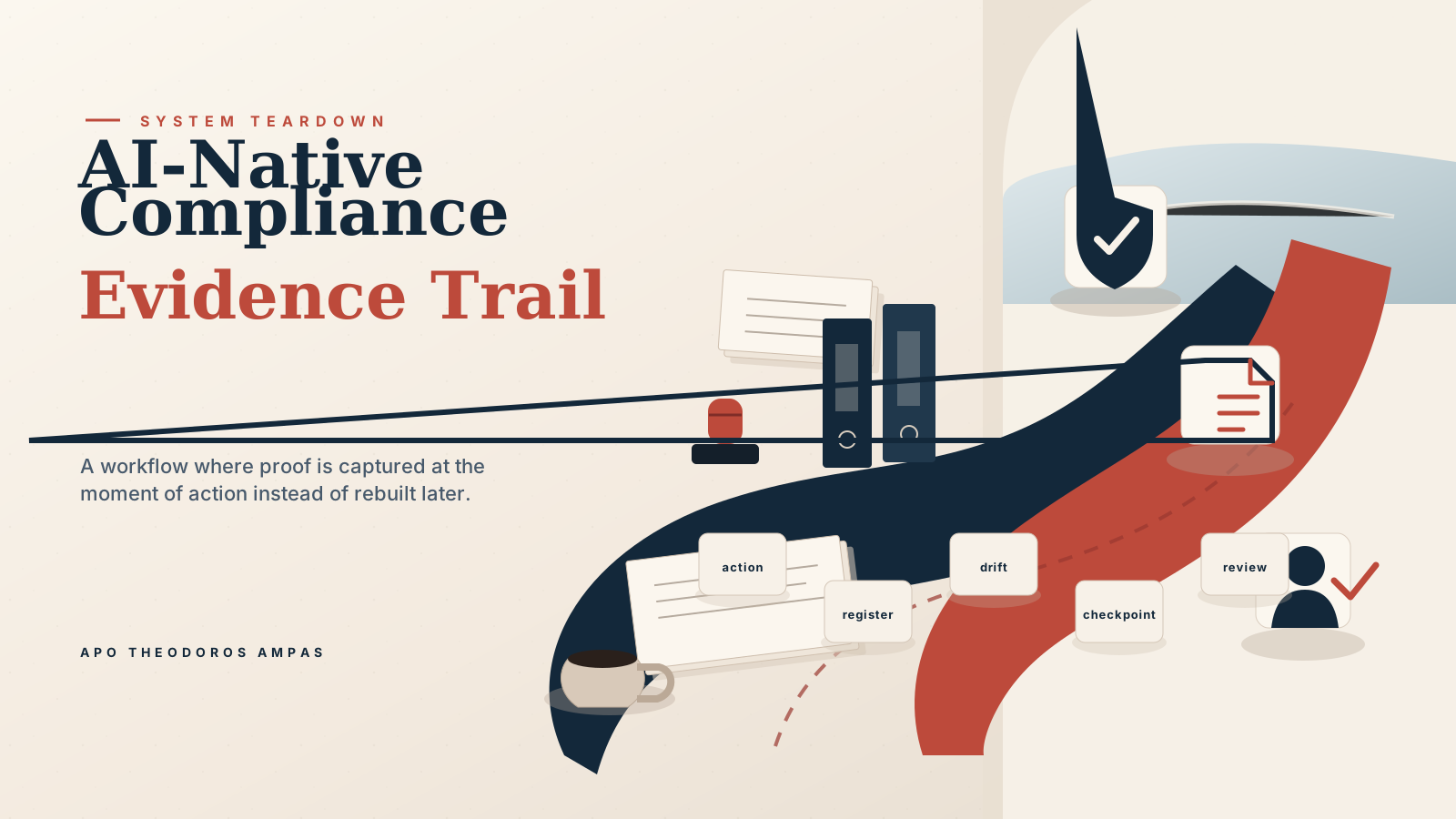
An old-route-to-AI-route teardown of AI compliance: why evidence of human review gets reconstructed after the fact, and what it looks like when it's captured automatically instead.
A system teardown of accounts payable: why three-way matching is still manual, and what an AI-native invoice processing route would automate and keep human.
The 1995 insurance claims workflow is a document relay between six people. Here's how I'd redesign it as an AI-native intake, triage, and settlement route.
A designed teardown of the coordination layer under Greek bookkeeping: inbox invoices, classification, myDATA transmission, rejections, and the accountant who still signs. A model, not a client build.
A designed teardown of the coordination layer under CE marking: product intake, requirement mapping, evidence gap analysis, test coordination, technical file generation, and the engineer who signs. A model from the lab, not a client build.
A designed teardown of the coordination layer under freight forwarding: structured intake, carrier rate aggregation, customs documents, booking, and human exception handling. A model from the lab, not a client build.
A designed teardown of the coordination layer under property due diligence: property identification, registry retrieval, document extraction, risk assembly, and professional review. A model from the lab, not a client build.
A designed teardown of the coordination layer under public procurement: tender discovery, qualification against capability, requirement extraction, bid assembly, and deadline tracking. A model from the lab, not a client build.
A designed teardown of the coordination layer under elevator compliance: asset registration, obligation discovery, a compliance calendar, contractor coordination, and certificate storage. A model from the lab, not a client build.
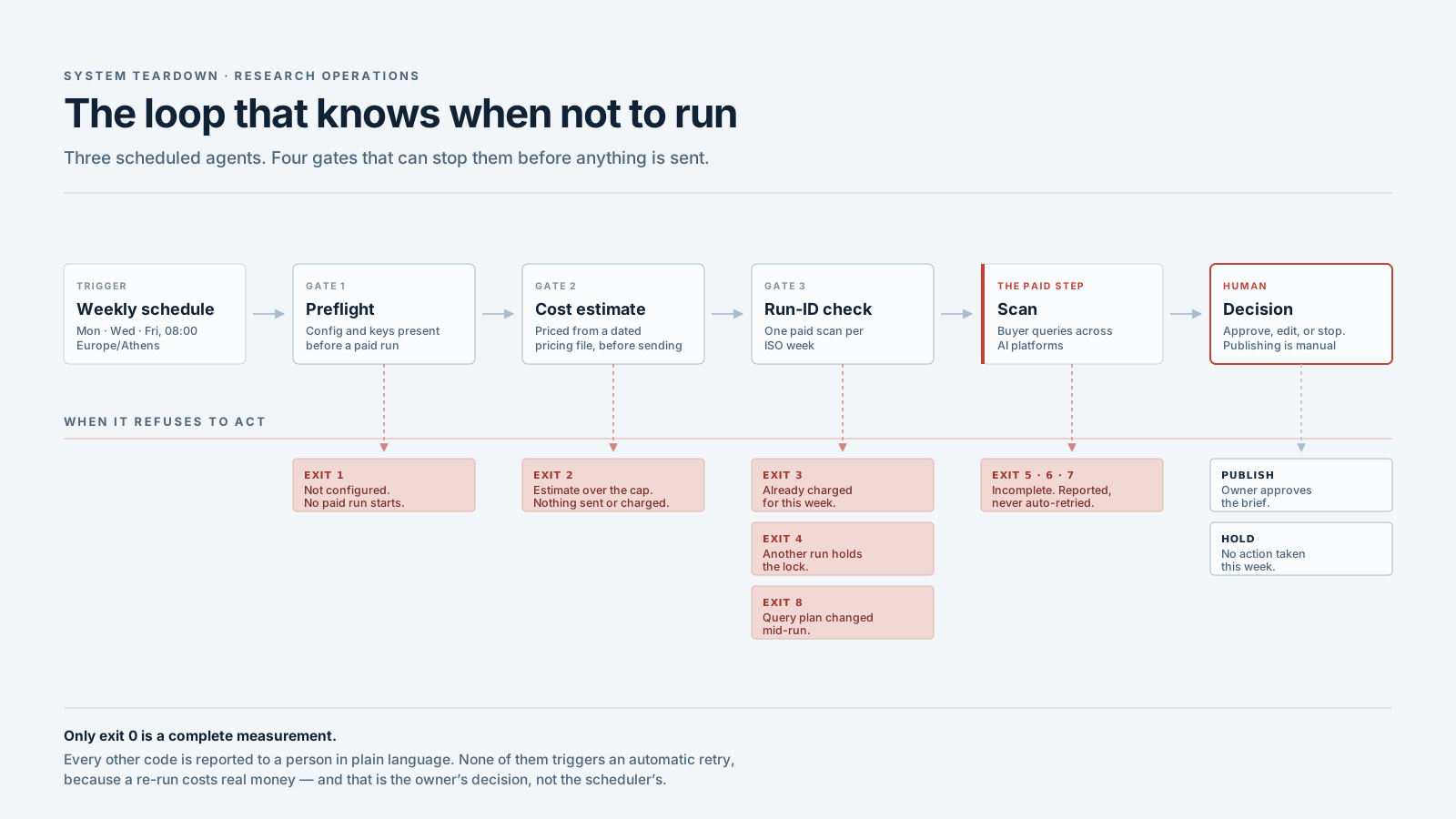
A first-hand teardown of the scheduled research system that runs my own SEO and AI-visibility work: three weekly agents, a pre-spend budget gate, an idempotency guard that refuses to pay twice, and an eight-code exit taxonomy that tells a human what actually happened.
A first-hand teardown of the sales follow-up loop I build inside a company's CRM: capture, research, draft, human approval, write-back, and supervised improvement. No invented conversion numbers.
Learn 7 proven ways to build customer trust in your online store: from security badges and reviews to clear policies: and turn hesitant visitors into buyers.
A practical guide to choosing the right ecommerce platform for your small business in 2026: what features matter, how to compare costs, and how to avoid an early migration.
"A practical guide to email marketing for ecommerce: build your list, set up automated flows, and turn subscribers into repeat customers: with real 2026 benchmarks."
A practical 2026 guide to ecommerce SEO: keyword intent, product page optimization, site structure, technical health, and content that ranks your online store on Google.
A practical guide to shooting professional product photos for your online store: even with a phone. Lighting, backgrounds, angles, editing, and AI tools.
Learn how to write product descriptions that sell with 8 practical, conversion-focused tips for your online store: from benefit-led copy to mobile scannability and SEO.
Cart abandonment costs online stores billions every year. Learn the top reasons customers leave without buying: and the practical fixes that bring them back.
"A plain-English guide to Generative Engine Optimization: what GEO is, how it differs from SEO, and how small businesses can get cited by AI answer engines."
By Theodoros Ampas
On email
Join the AI automation newsletter.
Personal notes, build updates, and practical lessons from AI systems, agents, automation, and the work behind them.
Free, no spam. Unsubscribe anytime.
Cookies and analytics
This site counts readers without storing anything on your device. Accepting also allows cookies and session replay, which show me where an article loses people. Decline and the counting stays anonymous. Read the cookie policy