What Should Stay Human When You Embed AI Into Operations?
A liability-based framework for deciding which decisions must stay human when you embed AI into business operations, and which are just coordination work.
On this page
Direct Answer
What stays human is any decision that carries legal liability, requires a licensed judgment, or touches a customer at a moment that can’t be undone. Everything else is a candidate for AI, regardless of how complex the task looks on paper. Most operations draw this line by task difficulty instead of by who owns the consequence when the system is wrong, and that is the mistake this piece is about.
Key Takeaways
- Liability, not difficulty, decides what stays human. A five-second signature can matter more than a two-hour analysis.
- Licensed acts (an accountant’s sign-off, a legal opinion, a diagnosis, a compliance certification) stay human because the license is what the AI cannot hold, not the skill behind it.
- Irreversible customer moments, like an account closure or a denied claim, need a person who can be argued with before the decision is final.
- Novel situations with no precedent are where models pattern-match confidently and wrongly. Route those to a person before the wrong pattern becomes policy.
- Article 14 of the EU AI Act already codifies a version of this for high-risk systems: oversight has to be commensurate with the risk, not applied as a blanket rule to every step.
What actually has to stay human?
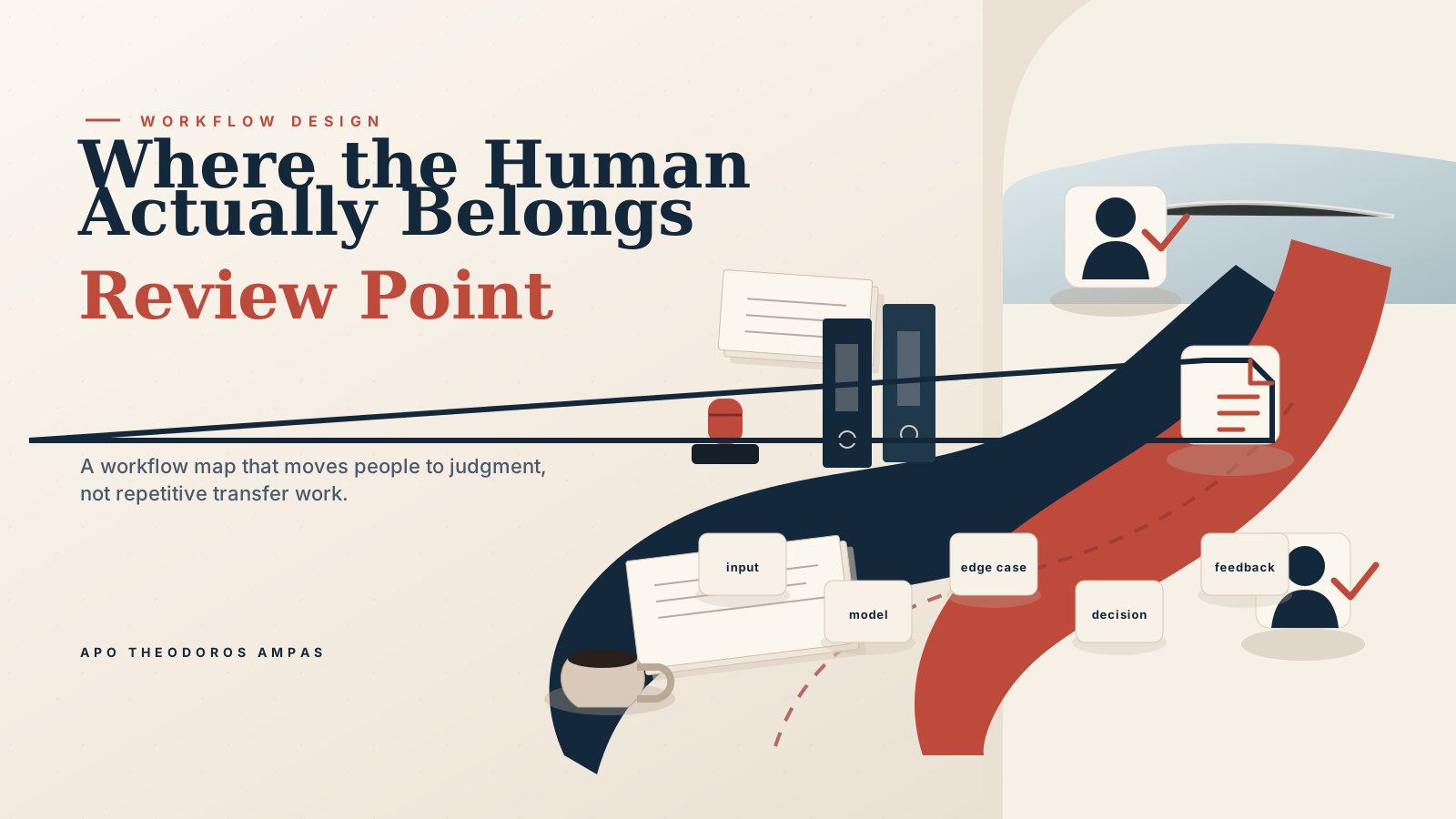
I map workflows for a living, and the question I get asked most is some version of “how much of this can we automate.” It’s the wrong question. The right one is: at which step does a name, a license, or a relationship attach to the outcome? Everything before that step is coordination, moving information between systems and people, and coordination is exactly what AI is good at removing. Everything at or after that step is a place where a person has to be able to say “I decided this,” and mean it.
Five categories keep showing up across the workflows I’ve mapped:
| Category | Why it stays human | Example |
|---|---|---|
| Liability sign-off | A specific person’s name backs the outcome legally | An accountant approving a VAT filing before it is submitted |
| Licensed act | The law restricts who may perform the act, not just who is capable of it | A diagnosis, a legal opinion, an insurance adjuster’s claim decision |
| Irreversible customer harm | The action can’t be reversed once it executes | Closing an account, denying a claim, canceling a contract |
| Novel judgment | No precedent exists for the model to match against | A complaint that doesn’t fit any existing category |
| Trust repair | The human’s presence is the product, not the information | Talking an angry customer down from canceling |
None of these are about the AI being bad at the task. A model can draft the VAT filing, summarize the claim file, or flag the complaint as unusual faster than a person can. What it can’t do is hold the license, absorb the liability, or repair a relationship by being present. Moody’s makes the same point about risk and compliance functions specifically: oversight keeps mattering precisely because accountability doesn’t transfer to the model. That is a structural limit, not a capability gap that better models close.
What this is not
This is not the same argument as human-in-the-loop workflow design, which I’ve written about separately, where human-in-the-loop actually belongs in an AI workflow is about where in a pipeline you insert an approval gate. This piece is upstream of that. It’s about which categories of decision should never be fully delegated regardless of gate placement, model accuracy, or how much the team trusts the system after six months of clean runs. Even as enterprises shift the mechanics of oversight from a blocking human-in-the-loop step to a supervisory human-on-the-loop model, the categories that require a person don’t move, only how closely that person watches does.
It’s also not a case for keeping humans everywhere out of caution. Most of the work inside a broken workflow (chasing a document, re-keying a field, checking a status three different people already checked) carries no liability and reverses easily if wrong. That work should move. Keeping a person in that loop “to be safe” is the same mistake in the other direction: it’s not a boundary, it’s a habit, and habits are exactly what most AI adoption projects get wrong by starting at the coordination layer instead of the decision layer.
How do you find this line inside a real workflow?
Map the workflow start to finish, the way I did for an AI-native insurance claims system and for a CE marking compliance system. At each step, ask three questions: does a license attach here, does this reverse if it’s wrong, and has this exact situation happened before. A “no” on reversibility or “no” on precedent is where the boundary sits, even if the step looks routine from the outside. In both of those systems, the document assembly, cross-referencing, and status tracking moved to the system. The signature that says the file is complete did not.
This produces a shorter list than most teams expect. In a claims workflow, the human boundary is usually one or two steps: the adjuster’s decision on borderline claims and the sign-off on payout above a threshold. Everything upstream (intake, document matching, policy lookup, fraud flagging for review) is coordination. It just doesn’t feel that way when it’s still done by hand, which is also why adding an AI agent on top of that workflow without redrawing the boundary first tends to fail.
Summary
The boundary between human and AI work isn’t about task difficulty, and it doesn’t move as models improve. It sits at the point where a license, a legal signature, or an irreversible customer consequence attaches to the outcome. Map a workflow looking for that point instead of looking for what feels hard, and the line holds even after the AI gets better at everything around it.
FAQ
Does a more capable AI model change what should stay human?
No. A better model changes how much drafting, summarizing, and coordination it can safely handle before the human step. It doesn’t change who holds the license or absorbs the liability, because that’s a legal and organizational fact, not a capability limit.
Isn’t this the same as human-in-the-loop design?
No. Human-in-the-loop is about where you place an approval gate inside a workflow. This is about which categories of decision should never be fully automated regardless of where the gates sit.
What if keeping a human in a low-risk step is just cheaper for now?
That’s a resourcing decision, not a boundary. It’s fine to keep a person somewhere temporarily. The distinction in this piece is about steps that should stay human on principle, not steps that happen to still be manual.
How do regulators define this boundary?
The EU AI Act’s Article 14 requires human oversight for high-risk AI systems to be commensurate with the risk, level of autonomy, and context of use, rather than uniform across every function, which is close to the liability-based line described here.
Does this apply to small teams without a compliance function?
Yes. The categories (liability, licensed acts, irreversible harm, novel judgment, trust repair) exist whether or not a company has a named compliance officer. Smaller teams just tend to notice the boundary later, usually after a bad edge case.
Frequently asked questions
Does a more capable AI model change what should stay human?+
No. A better model changes how much drafting, summarizing, and coordination it can safely handle before the human step. It doesn't change who holds the license or absorbs the liability, because that's a legal and organizational fact, not a capability limit.
Isn't this the same as human-in-the-loop design?+
No. Human-in-the-loop is about where you place an approval gate inside a workflow. This is about which categories of decision should never be fully automated regardless of where the gates sit.
What if keeping a human in a low-risk step is just cheaper for now?+
That's a resourcing decision, not a boundary. It's fine to keep a person somewhere temporarily. The distinction here is about steps that should stay human on principle, not steps that happen to still be manual.
How do regulators define this boundary?+
The EU AI Act's Article 14 requires human oversight for high-risk AI systems to be commensurate with the risks, level of autonomy, and context of use, rather than uniform across every function, which is close to the liability-based line described here.
Does this apply to small teams without a compliance function?+
Yes. The categories (liability, licensed acts, irreversible harm, novel judgment, trust repair) exist whether or not a company has a named compliance officer. Smaller teams just tend to notice the boundary later, usually after a bad edge case.