AI Automation vs Manual Work: Where the Handoff Should Actually Move
Where the AI-to-human handoff should actually sit in a workflow, using refund and return approval as the worked example.
On this page
Direct Answer
AI automation vs manual work is the wrong comparison. The real question is where the handoff between a system and a person should sit. AI should run every step a written rule already resolves: matching an order, checking a date, calculating an amount. A human in the loop belongs where the rule runs out: a disputed fact, a policy exception, or an amount above a threshold the business hasn’t pre-approved.
Key Takeaways
- “AI vs manual” is the wrong frame. The real question is which decisions in a workflow are already rule-bound and which ones require discretion: that’s what decides the handoff point, not the topic.
- In a refund and return workflow, most of the work (matching the order, checking the return window, calculating the amount) is a lookup. That part is automatable now, without a judgment call involved.
- The bottleneck is rarely the model’s confidence. It’s whether the business has written its exceptions down clearly enough for a rule to apply them.
- Humans should stay on refunds above a set threshold, disputed claims, repeat-refund patterns, and anything where the seller carries legal exposure the company hasn’t accepted in writing.
- A handoff with no context is worse than no handoff. The system has to pass along what it found and why it stopped, not just the ticket.
What problem does this system actually own?
Most teams draw the human/AI line by topic. Refunds go to a person. Password resets go to the bot. That line is wrong more often than it’s right, because a refund request and a password reset can each be either a lookup or a judgment call, depending on the specific case.
A refund inside the return window, for an eligible item, under the auto-approve amount, is a lookup: three facts, one written rule, one output. A refund for a used item outside the window, requested by a customer who’s filed three refunds this quarter, is a judgment call: the rule doesn’t clearly resolve it, and the cost of getting it wrong (fraud, or a lost customer) is real.
The actual problem this boundary has to solve isn’t “how much can we automate.” It’s routing each individual case to the right side of the line, case by case, instead of routing by category. Get that wrong in one direction and a person reviews things a rule already answered. Get it wrong in the other direction and a model approves something nobody signed off on.
The existing workflow I would map first
A customer messages support asking for a refund. An agent opens the order system and looks up the order date, the item, and the delivery date. They check whether the request falls inside the return window: in the EU, 14 days from delivery under the Consumer Rights Directive (2011/83/EU), no reason required. They check whether the item is eligible (not a category excluded from returns, not visibly used beyond what’s allowed). They decide: approve, deny, or escalate. All of this is manual work today, and almost none of it needs to be.
If it’s approved, the agent switches to the payment processor, manually issues the refund, and switches back to the helpdesk to write a reply. If the case is ambiguous (item shows some wear, request came in on day 16, customer wants a partial refund instead of a full one) the agent either invents a judgment call on the spot or pings a supervisor and the ticket sits.
None of that is hard in the sense of requiring expertise. It’s three systems (helpdesk, order database, payment processor) that don’t talk to each other, and a policy that exists in a document somewhere but isn’t connected to any of them. The agent’s actual job, most of the time, is carrying facts between systems and applying a rule from memory.
How the system would run
The same message arrives. The system pulls the order record automatically: delivery date, item, price, prior refund history on that customer. It computes days since delivery, checks item eligibility, and checks for a repeat-refund or fraud signal on the account.
Three outcomes, not one:
- Full match: inside the window, eligible item, under the auto-approve amount, no fraud signal. The system executes the refund through the existing payment API, writes the applied rule and timestamp back to the helpdesk as an audit trail, and sends the confirmation.
- Partial match: something is outside the clean case: the amount is above the threshold, or the item condition is ambiguous. The system drafts a recommendation and writes a structured escalation note: what the customer asked for, what the system found, which rule doesn’t clearly apply, and what it recommends. A person approves or overrides before anything executes.
- No match: the request is outside policy on its face (well past the window, no exception applies). The system drafts a denial with the specific reason cited, and a person can still review before it sends if the merchant wants that gate.
The design choice that matters is where “recommend” turns into “execute.” That line should be set deliberately by the merchant, in writing, not inferred by the system from past approvals.
| Step | Old route (manual) | What breaks |
|---|---|---|
| Look up order and delivery date | Agent searches the order system by hand | Slow under queue pressure; typos in dates or item IDs |
| Apply the return-window rule | Agent recalls or looks up the written policy | Policy drifts from what’s documented; agents apply it inconsistently |
| Decide approve, deny, or escalate | Full discretion on every ticket | Discretion applied even to cases the policy already answers |
| Process the refund | Agent manually triggers it in the payment tool | A second system, a second chance to key in the wrong amount |
| Reply to the customer | Written from scratch each time | Response time balloons during volume spikes |
What stays under human control?
Refunds above the threshold the business set on purpose, not a number the system worked out from history. Disputed facts, like a customer claiming an item arrived damaged with no photo and a conflicting delivery record. Repeat-refund patterns, where the useful judgment is reading an account holistically, not scoring one ticket. And any case the escalation note flags as “no rule covers this”: the system’s job there is to say so plainly, not to guess and hope the guess was inside policy.
There’s a counterintuitive case worth naming directly: the 14-day EU right of withdrawal is one of the more automatable refund scenarios, not one of the sensitive ones. It’s a hard legal rule (no reason required, reimbursement due within 14 days of notice) and a person is more likely to apply it inconsistently under time pressure than a system checking a date against a policy field. The instinct to keep a human on anything touching consumer law is backwards here. Humans earn their place on the cases the law and the policy document don’t already resolve, not on the cases they do.
This is also where a well-designed handoff earns its keep. Support teams that study AI-to-human handoffs converge on the same finding: a handoff works when the person picks up with full context (what was asked, what was found, why the system stopped) instead of re-reading the ticket from scratch. That’s the difference between a human in the loop who reviews in seconds and one who redoes the AI’s work.
When this is the wrong build
Low refund volume doesn’t justify a policy engine. If a merchant handles a handful of refund requests a week, the coordination cost was never the bottleneck, and building automation adds a system to maintain for a problem that wasn’t expensive.
Messy source data kills it before the model gets involved. If the order system has no reliable delivery-date field, or item eligibility lives in someone’s head instead of a policy document, the system is guessing with a confident tone, which is worse than a person guessing openly.
An unwritten policy is the real blocker, more often than the model. “We handle returns case by case” isn’t a policy a rule can apply: it’s an admission that the exceptions haven’t been decided yet. Write the policy first; the automation is the easy part after that.
And if leadership hasn’t committed to an auto-approve threshold in writing, don’t let the system infer one from what past agents happened to approve. That’s a liability decision, and it belongs to a person who can be held to it.
How this connects to other workflows
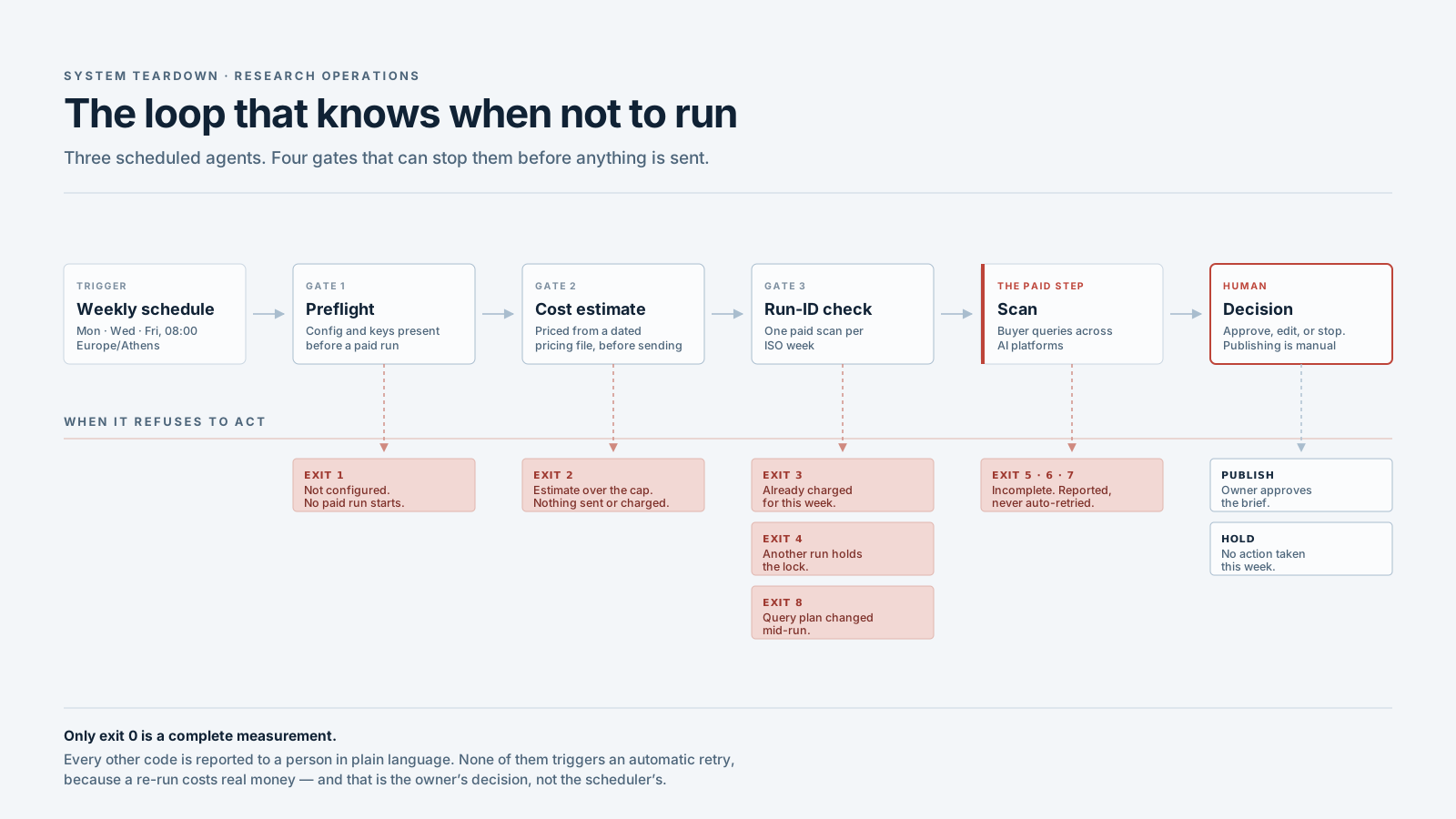
The same boundary-drawing logic is the thesis behind where human-in-the-loop actually belongs in an AI workflow: the line moves with what’s rule-bound, not with how sensitive a topic sounds. It’s also the same shape as the AI sales follow-up loop I run inside a CRM (draft, context, approval, write-back) and the same discipline behind the research loop that knows when not to run, which stops rather than guesses when its own rules don’t cover a case. A bookkeeping system that hides the ledger draws this exact line around a different set of numbers.
Summary
The handoff line moves once: when the policy is written down clearly enough for a rule to hold it. Until that happens, shifting work from a person to a model doesn’t remove the guesswork in a refund decision: it just moves the same guesswork somewhere less accountable, dressed up as automation. The businesses that get this right aren’t the ones with the most AI in the workflow. They’re the ones that did the unglamorous work of writing their exceptions down first.
Frequently asked questions
Is AI automation supposed to replace manual customer support work entirely?+
No. It replaces the coordination and lookup part of a decision (pulling records, applying a rule that's already written down) while judgment calls stay with a person.
Where does human-in-the-loop actually belong in a refund workflow?+
On the decisions the business hasn't reduced to a rule: amounts above the auto-approve threshold, disputed facts, and repeat-refund patterns.
Does EU consumer law allow refunds to be automated?+
Under the EU Consumer Rights Directive (2011/83/EU), a customer can withdraw within 14 days of delivery without a reason, and the seller must reimburse within 14 days. Because that outcome doesn't depend on discretion, it's one of the easier refund cases to automate.
What's the actual difference between automation and an AI-native workflow here?+
Automation triggers a fixed action from a fixed input. An AI-native workflow reads an unstructured message, checks it against a rule set, and produces either an executed action or a structured handoff to a person.
What parts of a refund workflow can AI automate today?+
Order lookup, return-window and eligibility checks, amount calculation, and execution for cases that fully match a written policy. Disputed or above-threshold cases still need a person to approve.