5 Components That Help Practitioners Scale Human-in-the-Loop Automation
Five practical components for practitioners to design and scale human-in-the-loop automation, prevent review bottlenecks, and capture feedback for retraining.
On this page
Human-in-the-loop automation places a person at specific decision points inside an otherwise automated workflow, reviewing, correcting, or approving model output before it takes effect. It belongs wherever a decision is high-stakes, ambiguous, or hard to reverse, since human judgment there reduces risk more than it costs in speed. The trade-off is straightforward: you gain accuracy and accountability, and you pay for it in latency and reviewer staffing.
TL;DR:
- Human-in-the-loop systems require accurate confidence scoring, effective routing, and a streamlined review interface to avoid deployment failures.
- Properly designed checkpoints should be anchored at irreversible high-risk moments, not at every model output, to prevent reviewer burnout and bottlenecks.
- Selecting the most expensive mistake for human oversight, rather than every decision, improves scalability and maintains fast response times.
- Operational metrics like review throughput, error rate reduction, decision time, and rework rate are essential to measure cost-effectiveness and trust calibration.
- Embedding HITL in existing tools and starting with a decision criteria matrix ensures the workflow adapts effectively as model reliability improves.
What Is Human-in-the-Loop Automation, Exactly?
Human-in-the-loop (HITL) automation is a design approach where human judgment is deliberately built into an AI or automation workflow to manage high-stakes decisions, resolve ambiguity, or catch errors before they cause damage. IBM defines the mechanism as a continuous cycle: the model produces an output, a person reviews or corrects it, and that correction feeds back into the system to improve future performance. That feedback loop is the entire point. Without it, you just have a human rubber-stamping machine work, which is expensive theater, not HITL.
The term covers two distinct placements, and confusing them causes most implementation headaches:
- Training-time HITL (active learning, machine teaching, reinforcement learning from human feedback) uses human labeling and correction to improve the underlying model before it ever reaches production.
- Operational HITL inserts a person at runtime, approving or rejecting specific actions as they happen, regardless of how good the model already is.
A systematic review of HITL AI systems classifies systems by exactly this loop placement, along with interaction granularity, and flags trust calibration and explainability as the recurring design tensions. You don’t have to pick one mode. Most mature systems run both simultaneously: a training loop that gets smarter over months, and an operational loop that catches today’s edge cases.
Deciding whether a workflow needs HITL comes down to three quick filters: how reversible is the action, how regulated is the domain, and how much does a wrong answer cost you if nobody catches it. If all three point toward “low stakes, easily undone,” automate it fully. If any one points toward “high stakes, hard to undo,” build the checkpoint.
How Does the Human-in-the-Loop Mechanism Actually Work?
A working HITL system has five moving parts, and skipping any one of them is usually where deployments fail.
- Confidence scoring. The model attaches a certainty value to its own output, which determines whether the case proceeds automatically or gets flagged.
- A routing engine. This decides who sees a flagged case, in what order, and how urgently, based on rules like case type, dollar value, or customer tier.
- A review interface. The screen a reviewer actually works in. If it’s cluttered or slow, throughput collapses regardless of how good the model is.
- Audit logs. A record of what the model proposed, what the human decided, and why, which matters for compliance and for retraining.
- Governance rules. Who can override what, and under what escalation path, when a reviewer disagrees with the system or with another reviewer.
Databricks frames the core discipline as risk-based routing: confidence thresholds and risk scoring send only a subset of decisions to a human, rather than every single one. That’s what keeps HITL scalable instead of collapsing into a manual review queue that grows faster than your team.
Four patterns show up repeatedly across mature deployments:
- Selective escalation sends only low-confidence or high-risk cases to a person, letting everything else pass through automatically.
- Risk-aware autonomy expands the model’s independent authority gradually as its track record improves, rather than fixing the human/machine split permanently.
- The data flywheel treats every human correction as training data, so the system’s confidence scoring gets sharper over time.
- Stage-gated delivery requires human sign-off at defined milestones (a draft, a database write, a customer-facing send) rather than at every micro-step.
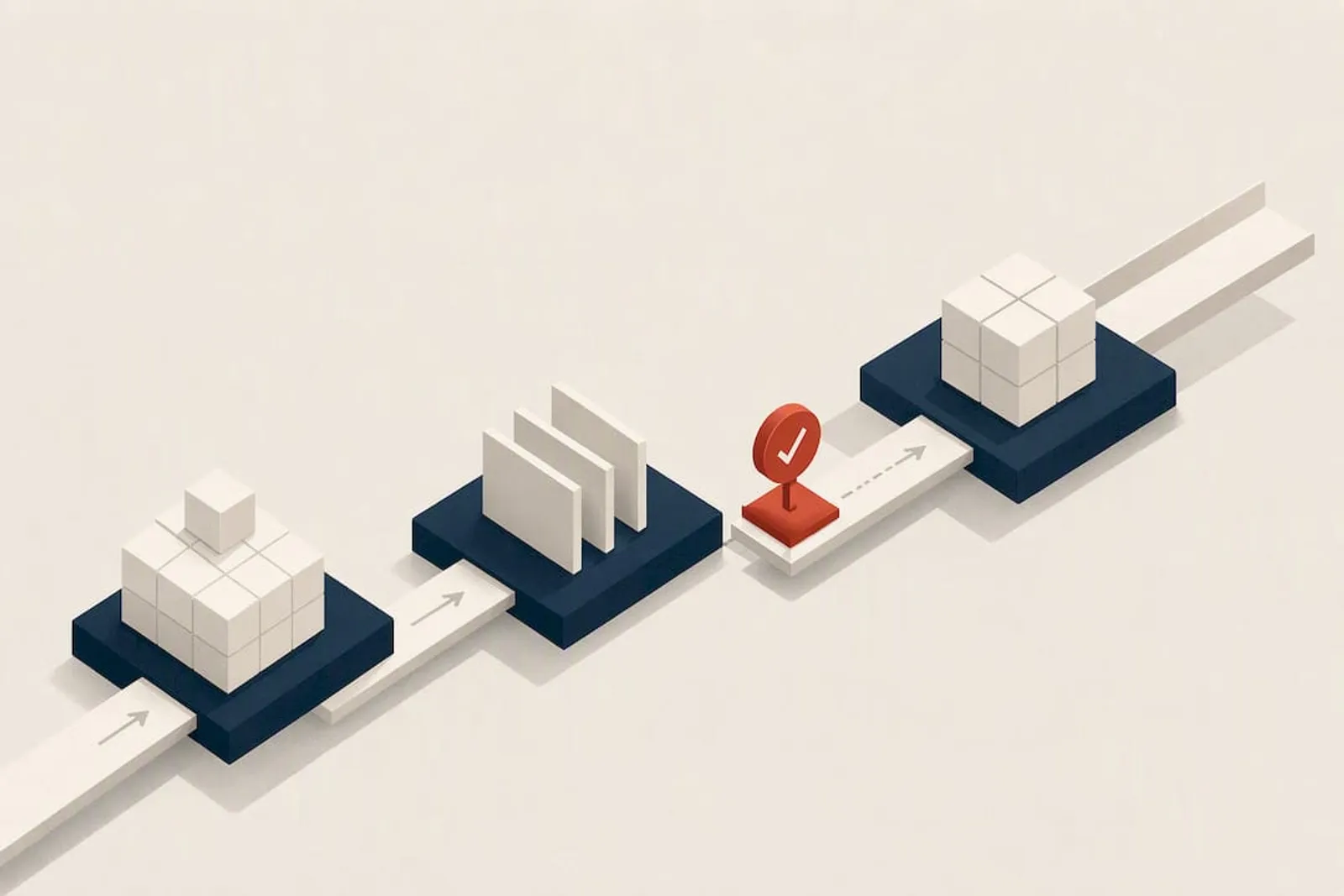
Review nodes belong at genuinely irreversible moments: before a message leaves the company, before a database write posts, before money moves, before an account gets closed. Practitioner guidance from n8n recommends anchoring approvals specifically to those high-risk junctures and pairing each one with a timeout and escalation path, so a stalled review doesn’t stall the whole workflow.
Pro Tip: Build your first HITL checkpoint at the single most expensive mistake your workflow could make, not at the step that feels the most “AI.” Teams that start by reviewing everything the model touches burn out reviewers in weeks.
What Benefits Does Human Oversight in AI Actually Deliver?
The case for human oversight in AI rests on four measurable benefits, not a vague sense of caution:
- Accuracy and reliability. A person catches edge cases a model was never trained on, particularly rare combinations of inputs.
- Accountability. When a named person signs off on a decision, you have someone who can explain it, which matters in regulated industries and in disputes.
- Explainability and compliance. Audit trails from human review satisfy regulators and internal governance in ways a black-box model score alone cannot.
- Safer early deployments. New models or workflows can go live sooner because a human backstop limits the downside while the system proves itself.
Stanford HAI frames this as an ethical design stance as much as an engineering one: humans stay in charge of consequential decisions, with AI kept “in the loop” rather than the reverse.
None of that is free. Every review adds latency, sometimes seconds, sometimes hours if a reviewer is unavailable. Staffing reviewers costs money that scales with volume, not with model improvements. Cognitive load on reviewers rises when case complexity is high, and burned-out reviewers make more mistakes, not fewer. There’s also a subtler risk: automation bias, where reviewers start rubber-stamping model output because it’s usually right, and stop catching the times it isn’t.
By the numbers: Track four operational metrics from day one: reviewer throughput (cases cleared per hour), error rate reduction (post-review versus pre-review accuracy), time-to-decision (how long a flagged case sits before resolution), and rework rate (how often a human decision gets reversed later). These four numbers tell you whether your HITL layer is earning its cost.
How to Design a Human-in-the-Loop System That Scales
Most HITL failures trace back to a design phase that skipped one of these steps.
- Build a decision criteria matrix. Score each workflow step on risk, volume, and reversibility. High risk and low reversibility gets a checkpoint regardless of volume; low risk and high reversibility should stay fully automated even at scale.
- Write concise review guidelines before launch. Reviewers making inconsistent judgment calls is a training problem, not a personnel problem, and it’s cheaper to fix with a one-page rubric than after six months of drift.
- Design the review UI for speed. A reviewer should see the model’s proposed action, its confidence score, and the relevant context in one screen, with a single click to approve, reject, or edit.
- Set timeouts and escalation paths. Decide in advance what happens when a reviewer doesn’t respond in time, and route to a backup reviewer automatically rather than letting the case sit.
- Capture every correction as structured feedback. Record not just the final decision but why the reviewer overrode the model, since that reasoning is what actually retrains the system.
- Label consistently. Use the same categories and tags across reviewers so the corrections you’re collecting are usable as training data later, not a pile of inconsistent notes.
- Build in governance and privacy controls from the start. Decide who can see what case data, and how long review records are retained, before your first production case, not after an audit flags the gap.
DistilledPatterns frames this well: treat human review as a planned production mode with defined staffing and metrics, not an informal fallback you bolt on when the model gets something wrong in front of a customer. The automation boundary is supposed to move over time. If you never revisit which steps still need a human, you’ve built a permanent cost center instead of a temporary safety net.
Pro Tip: Assign a backup reviewer to every checkpoint before launch, not after the first missed SLA. A single point of failure in your review queue defeats the purpose of having a queue at all.

Where Does Human-in-the-Loop Automation Actually Get Used?
Three environments show the pattern clearly, each routing a different kind of decision to a person.
- Contact centers: the model drafts a response, and an agent approves or edits it before it reaches the customer; low-confidence or emotionally charged messages escalate automatically. Track approval rate, edit distance between draft and sent message, and average handle time.
- Document processing and finance operations: the model prefills extracted fields (amounts, dates, vendor names) from invoices or forms, and a human corrects errors before the record hits the database. Track field-level accuracy, correction rate per document type, and processing time per batch.
- Autonomous agents: an agent pauses before any high-impact action, sending an external email, updating a CRM record, or moving money, and waits for explicit approval. Track pause frequency, approval-to-rejection ratio, and time from pause to resolution.
That routing decision, more than any model tuning, is what determines whether the system feels fast or feels like a bottleneck.
What Goes Wrong With Human-in-the-Loop Systems?
Three failure modes account for most troubled HITL deployments, and each has a known fix.
- Queue bottlenecks. Volume spikes overwhelm reviewer capacity, and cases pile up past their usefulness window. Fix it with hard SLAs, auto-escalation when queues exceed a threshold, and pre-authorized backup reviewers on standby.
- Reviewer drift. Different reviewers apply different standards over time, especially across shifts or regions. Combat it with inter-rater reliability checks, sampled audits of closed cases, and recurring calibration sessions where reviewers compare notes on edge cases.
- Automation bias. Reviewers start approving model output reflexively once it’s been right often enough. Empirical research on human-AI trust calibration documents this directly: human error detection drops measurably as model accuracy climbs, precisely because trust outpaces scrutiny.
By the numbers: The same research shows that overtrust isn’t a training gap you can eliminate once. It requires ongoing calibration, meaning explainability features, periodic confidence-threshold audits, and randomized “cold checks” where a case is reviewed blind, without the model’s suggestion visible, to see if the reviewer reaches the same conclusion.
The right moment to remove a review checkpoint is when sampled audits show the model consistently outperforms average reviewer judgment on that specific case type, not when leadership simply gets tired of paying for review time.
Lessons From Embedded AI Implementations
Projects that embed AI directly inside a company’s existing tools surface a consistent pattern: the workflows that succeed are the ones where checkpoints get placed sparingly and adjusted as trust builds, not the ones where every output gets a human gate on day one.
- Early over-approval kills adoption faster than early model error does. Teams stop trusting a system that asks for sign-off on low-stakes actions.
- Feedback capture has to be designed in from the start. Retrofitting a way to record reviewer corrections after launch means losing months of usable training signal.
- Integration inside tools the team already uses (CRM, inbox, ticketing system) matters more than the sophistication of the model itself. A perfect model in a tool nobody opens gets ignored.
Readers building this out internally can find deeper implementation notes on where human-in-the-loop actually belongs in a workflow and on what should stay human when you embed AI into operations.
The Strategic Question: When Should Humans Stay in the Loop?
Ship with humans in the loop when uncertainty is high and partial automation still creates value. As reliability climbs, shift human effort from full correction toward spot verification and audit, and treat the automation boundary as something that moves. It should never be treated as a fixed cost.
Theodor
Get Hands-On Help Implementing Human-in-the-Loop Workflows
Reading a design checklist is one thing. Wiring confidence thresholds, routing logic, and review interfaces into the CRM and tools your team already uses every day is another. Theodorosampas works as an embedded AI partner, auditing existing workflows, then building the automation and human checkpoints directly inside your infrastructure, so the system reduces rollout risk instead of adding a new one.

That embedded model matters specifically for HITL, since the biggest failure point isn’t the AI logic. It’s a review queue nobody staffed correctly or a feedback loop nobody wired back into the model. Theodoros Ampas handles the audit, the build, and the feedback capture as one engagement, and leaves your team with a system they understand and can run without ongoing dependency on an outside agency. If you’re planning a rollout and want the checkpoints placed correctly the first time, start with a workflow audit and implementation review.
FAQ
What Is Human-in-the-Loop Automation?
It’s a workflow design where a person reviews, corrects, or approves AI-generated output at defined points, and those corrections feed back into the system to improve future performance.
What Is the Human-in-the-Loop Mechanism?
The mechanism is a repeating cycle: the model produces an output, a confidence score or rule flags certain cases for human review, a reviewer approves or corrects them, and that correction becomes feedback for the model or the operational process.
What Is the Human-in-the-Loop Strategy?
The strategy is risk-based: route only high-stakes, ambiguous, or low-confidence decisions to a human, automate everything else, and shift the boundary between the two as the model’s track record improves. Some firms build this routing logic directly into a company’s existing tools rather than as a separate add-on system.
What Is Human-in-the-Loop Simulation?
In simulation and training contexts, human-in-the-loop means a person actively participates in a live simulated environment, making real-time decisions the system responds to, rather than only reviewing a model’s output after the fact.
How Is Human-in-the-Loop Different From Human-on-the-Loop?
Human-in-the-loop means a person actively participates in individual decisions before they take effect; human-on-the-loop means a person monitors an autonomous system and can intervene, but the system generally acts on its own unless overridden.